Fashion
Spotlight: Feacle Matter
Written By Eshana Nanar

In the realm of fashion, there are artists who create clothes, and then there are artists who create worlds. Fecal Matter, better known as Matières Fécales exists entirely in the second category, encapsulating a world mixed with humanity in its truest form and disruption in the highest regard.
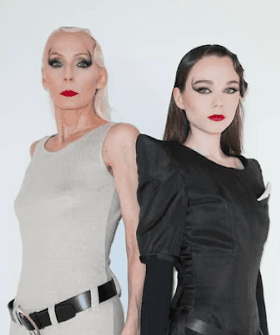
Founded by Hannah Rose Dalton and Steven Raj Bhaskaran originally in 2014, the Montreal-based duo didn’t come up through the usual fashion system. They both grew up in relatively sheltered environments where self-expression was pushed far under the surface. They built this from the ground up, selling pieces online on Depop, creating from whatever materials they had, and using their own bodies as extensions of the work. You can feel that origin in everything they do. It’s raw, it’s intentional, and it’s completely uninterested in being digestible.
Aesthetically, their work gets labeled as “alien” or “post-human,” but that almost feels too surface-level. What they’re really doing is stripping away the expectation that the body needs to be flattered or even recognized. The silhouettes distort. The materials mimic skin but don’t quite belong to it. The heels look like they grew out of the body rather than being worn by it. It’s unsettling, and that’s the point.
Because underneath all of that is a deeper question: why are we so attached to looking acceptable? Why is the human body deemed to be so shocking?
Because underneath all of that is a deeper question: why are we so attached to looking acceptable? Why is the human body deemed to be so shocking?
Somewhere along the way, fashion stopped simply being about expression and started becoming about control. Bodies are constantly being filtered, edited, disciplined, and reshaped into something more “palatable,” something easier for society to consume. And the industry has built an empire around that discomfort. Entire markets thrive off convincing people that their natural state is somehow unfinished.
That is why moments of visible skin, unconventional silhouettes, or bodies existing outside of rigid beauty standards still create such intense public reactions. They challenge the illusion that perfection is natural. They expose how manufactured our standards really are. The outrage is rarely just about the clothing itself, it is about the discomfort of seeing a body exist unapologetically without asking permission to be accepted first.
And fashion houses know this. Controversy has become one of the industry’s most valuable currencies. The more something disrupts traditional ideas of femininity, masculinity, modesty, or beauty, the more conversation it generates. But in a wider sense, this is reshaping the industry entirely. Fashion is no longer selling only garments; it is selling ideology, identity, and cultural positioning. Designers are increasingly expected to make statements about politics, sexuality, gender, and power through clothing, whether intentionally or not.
But perhaps the most interesting shift is that audiences are beginning to reject the idea that beauty must always look polished, restrained, or “appropriate.” Younger generations, especially, are gravitating toward fashion that feels emotionally honest rather than traditionally acceptable. They are more interested in individuality, imperfection, and personal narrative than in dressing to meet old societal expectations
And that's why there's something contradictory in the way the pair approaches fashion, not soft or calming, but confrontational. Like holding up a mirror that doesn’t reflect you the way you expect. Their work forces you to sit with discomfort and ask yourself where your ideas of beauty even came from. And once you start questioning that, it’s hard to go back.
Even their name, deliberately provocative, speaks to that tension. The shock factor and spectacle of something so inherently human. The idea that something can appear glamorous on the surface while hiding something more complicated underneath. It’s not subtle, and it’s not supposed to be. This is a brand that communicates in extremes because the system it’s critiquing thrives on illusion.
And culturally, the timing makes sense. Fashion is in a strange place right now. Everything is hyper-visible, hyper-referenced, and constantly recycled. Trends move so fast they barely mean anything. Individuality gets flattened into aesthetics that can be replicated in seconds. There’s a kind of exhaustion in that.
Spending time with their world through their visuals, their presence, and the way they speak about what they do, it becomes really clear that this isn’t about clothes in the traditional sense. It’s about disruption. Not in a trendy, algorithm-friendly way, but in a way that actually unsettles you. The kind that lingers.
Matières Fécales cuts through it by doing the one thing most brands avoid: they make you uncomfortable without explaining themselves. By stripping themselves bare and putting bodies on display while maintaining maximal individuality.
And that’s powerful.
Because this isn’t about creating something universally appealing. It’s about creating something honest. Something that doesn’t ask for approval before it exists. In a landscape where so much of fashion is about being consumed, this feels like resistance. Not polished. Not easy. But real in a way that’s becoming increasingly rare.